
Walk into almost any electronics market in Lagos, Abuja, or Port Harcourt and you will find hybrid inverters in every stall. They are sold alongside generators, discussed in WhatsApp groups, and specified on proposal documents that clients sign without fully understanding what they are buying. This is not a criticism of clients — it is an observation about how rarely the product is properly explained.
The hybrid inverter is not simply "a better inverter." It is a fundamentally different category of device — one that manages three separate power sources simultaneously, makes real-time decisions about which source to use and when, and can — when correctly specified and installed — eliminate or dramatically reduce generator dependency in a way that a standard inverter or simple battery system cannot.
This article gives you the complete picture. Not a simplified marketing version — the actual engineering explanation, written in plain language.
What Makes a Hybrid Inverter "Hybrid"
A standard off-grid inverter takes DC power from a battery and converts it to the AC power your appliances run on. That is its one function. A standard grid-tie inverter takes DC power from solar panels and converts it to AC power that it feeds into the grid — with no battery storage involved.
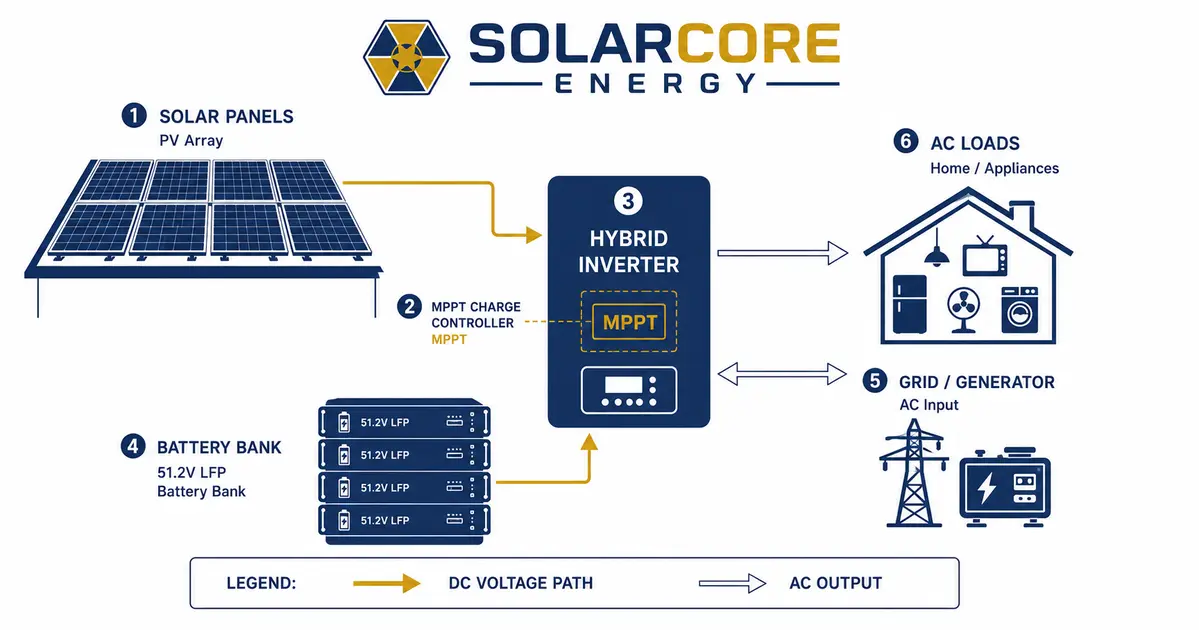
A hybrid inverter does both simultaneously — and more. It manages three separate power inputs at once: the solar PV array, the battery bank, and the utility grid (or a generator). The word "hybrid" refers to this ability to interface with all three sources and seamlessly switch between them based on availability and priority settings.
In the Nigerian context, where grid supply is unreliable and generator running costs are significant, this three-source management capability is precisely why hybrid inverters have become the dominant product category for residential and commercial solar installations.
The Three Power Sources and How They Are Managed
Source 1 — Solar PV Array (via Built-In MPPT)
The solar panels are connected to the hybrid inverter through a built-in Maximum Power Point Tracker (MPPT). The MPPT is a sophisticated charge controller that continuously varies the electrical load it presents to the solar array in order to extract the maximum available power at any given moment.
Solar panels do not produce a fixed output. Their voltage and current change continuously with irradiance (sunlight intensity), temperature, shading, and the electrical load connected to them. Without an MPPT, panels would operate at a fixed voltage determined by the battery — which is almost never the voltage at which they produce their maximum power. The MPPT finds and tracks the "sweet spot" on the panel's power curve, converting that optimal DC input voltage into the specific DC voltage needed to charge the battery. On a well-designed system on a clear day in Lagos, the MPPT stage alone can improve energy harvest by 20–30% compared to a simple direct-connection charge controller.
The MPPT input has two critical specifications: the maximum input voltage it can accept from the solar array, and the maximum current it can handle. These specifications determine how many panels can be connected in series and in parallel — which is why we always size the solar array against the MPPT specification, not the battery nominal voltage.
Source 2 — Battery Bank
The battery bank is the hybrid inverter's primary storage reservoir. When solar generation exceeds the building's load, the surplus flows into the battery. When load exceeds solar generation, the battery discharges to supplement. When solar is unavailable entirely (nighttime, heavy cloud cover), the battery powers the load independently.
The hybrid inverter manages the battery through a multi-stage charging algorithm: bulk charging (pushing maximum current into a depleted battery), absorption (maintaining a fixed voltage while current tapers as the battery fills), and float (maintaining a lower holding voltage for a fully charged battery without overcharging). For lithium iron phosphate (LFP) batteries, this algorithm is modified with a battery management system (BMS) communication protocol — often via CAN bus or RS485 — so the inverter and battery exchange real-time state-of-charge data and protection signals.
The battery's nominal voltage — 48V for most residential systems — must match the inverter's battery port specification exactly. This is a hard requirement, not a preference. A 48V inverter battery port connected to a high-voltage battery stack will cause immediate fault conditions or permanent damage.
Source 3 — Grid or Generator Input
The hybrid inverter's AC input port accepts power from either the utility grid or a generator. This input serves two purposes: supplementing the load when battery and solar are insufficient, and charging the battery when solar is unavailable and battery reserves are low.
On most residential hybrid inverters, a configurable current limiter on the AC input prevents the inverter from drawing more than a set amount from the grid or generator — which is essential when using a small generator whose capacity must be shared between charging and running loads. This setting is found in the inverter's configuration menu and must be set correctly during commissioning.
Power Priority — How the Inverter Decides What to Use
The hybrid inverter continuously runs a decision algorithm — many times per second — that determines how power is routed. The logic, simplified, operates in this order:
- Solar first: available solar generation goes directly to powering the load. No battery, no grid, no generator. This is the lowest-cost and most efficient state.
- Solar surplus charges battery: if solar exceeds the load demand, the surplus flows into the battery until it is full.
- Battery supplements solar shortfall: if load exceeds solar generation, the battery makes up the difference — without engaging the grid or generator.
- Grid or generator is engaged: only when battery state-of-charge drops below the configured low-battery threshold (set by the installer — typically 20% for LFP batteries) does the inverter switch in grid or generator power.
- Grid or generator charges battery: if the AC source is available and the battery is depleted beyond a set threshold, the inverter also directs charge current into the battery while continuing to power the load.
These priority levels are user-configurable on most hybrid inverter models — which is both an advantage and a source of misconfiguration risk. An inverter set to "utility first" by a careless commissioning engineer will prioritise grid power over solar and defeat the entire economics of the system. Correct priority configuration is a commissioning step that must be verified and documented on every installation.
The Output Stage — How AC Power Reaches Your Appliances
The hybrid inverter's output stage converts DC power (from whichever source the priority logic selected) into clean 230V 50Hz AC power — the standard voltage and frequency of the Nigerian electricity supply. Modern hybrid inverters produce pure sine wave output, which is essential for powering sensitive electronics, variable-speed motor loads (like inverter air conditioners), and any equipment with active power factor correction.
Some lower-cost units produce modified sine wave output — which can damage motors, cause excessive heat in transformers, and produce audible buzz in audio equipment. All systems designed and installed by Solarcore Energy use pure sine wave hybrid inverters. This is not a premium specification — it is the minimum standard for a properly designed system.
Transfer Time — What Happens When the Grid Goes Off
When the utility grid disconnects or the generator is switched off, the hybrid inverter must transition to battery-powered output without interrupting the load. The speed of this transition — measured in milliseconds — determines whether sensitive electronic equipment (computers, servers, medical devices, laboratory instruments) experiences any disruption.
Most quality hybrid inverters achieve transfer times of less than 20 milliseconds — fast enough that computers, routers, and most electronics do not detect the transition. Some models achieve sub-10ms transfer, which is essential for uninterruptible power supply (UPS) grade applications. For residential use, standard transfer times are acceptable. For server rooms, medical equipment, or critical loads, the transfer time specification must be checked at the design stage and documented in the project specification.
Why This Understanding Matters for Every Buyer
The hybrid inverter is the most expensive single component in most solar systems — and the one whose specification errors are the most consequential. An undersized MPPT wastes solar harvest. An incorrect battery voltage match creates fault conditions. A misconfigured priority setting reverses the economics of the entire installation. An inferior output waveform damages connected equipment.
Every one of these errors is avoidable through correct specification and commissioning. At Solarcore Energy, every project specification documents: MPPT input voltage range and its compatibility with the proposed panel string design, battery nominal voltage compatibility, pure sine wave output confirmation, transfer time specification, and priority configuration settings. These are not optional line items — they are engineering fundamentals that determine whether your system performs as designed.
Understanding your hybrid inverter is not an academic exercise. It is the foundation for having an informed conversation with your installer, reviewing your proposal with confidence, and knowing whether the system commissioned in your building is set up correctly.
Start With an Engineering-Led System Design
Every Solarcore proposal specifies the inverter against your actual load, documents MPPT compatibility with your panel configuration, and confirms commissioning settings before handover.
Joseph Olubato
Founder & Principal Solar Engineer, Solarcore Energy Limited. 10+ years engineering energy and telecom infrastructure across Nigeria and West Africa.