
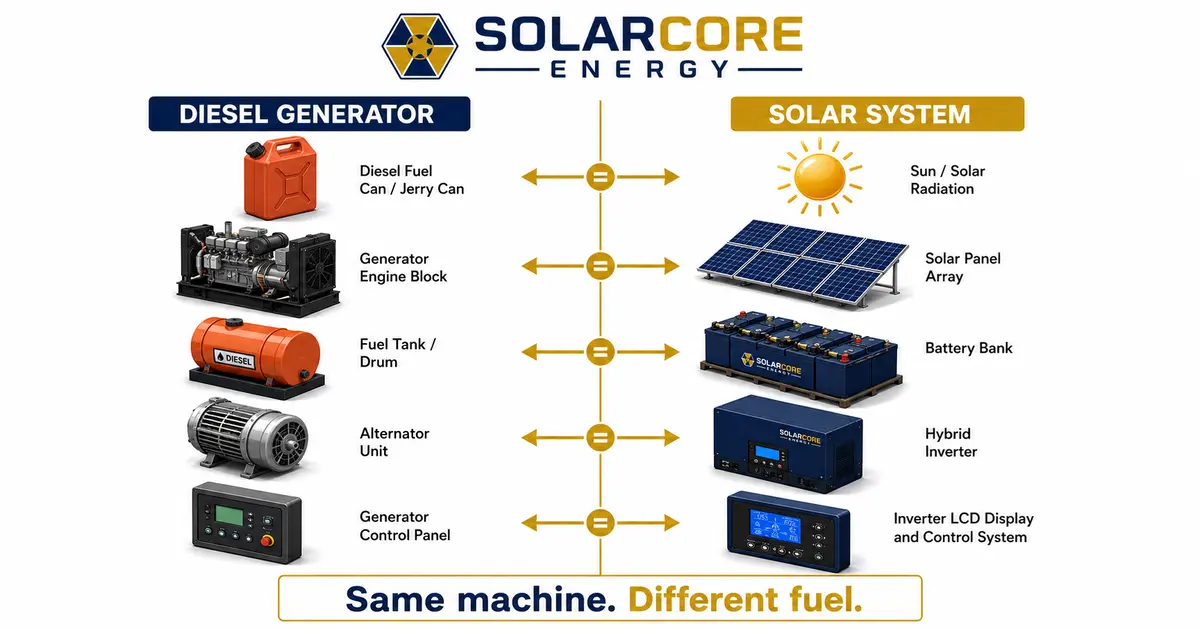
Let us start with something every Nigerian property owner already knows how to use and understand: the diesel generator.
You know how it works. You pour diesel into the fuel tank. You start the engine. It burns the fuel and produces electricity. That electricity powers your home or office until the tank runs dry, at which point you pour in more diesel and continue. The bigger your load — the more appliances you run — the faster the fuel gets consumed. Run the air conditioner on a 7.5kVA generator alongside the fridge, the TV, and the lights, and you might get five hours from a full tank. Run just the lights and a fan, and that same tank lasts three times as long.
Simple. You have been operating on this logic for years, whether consciously or not.
Now here is the insight that makes solar suddenly make complete sense: your solar power system is the same machine. It just runs on a different fuel — one that costs nothing, arrives every morning without you calling anyone, and never runs short.
Component by Component: The Solar System and the Generator
Let us map every part of your generator to its solar equivalent. Once you see this, you will never find solar confusing again.
The Fuel — Diesel vs Sunlight
In a diesel generator, everything begins with the fuel. No fuel, no electricity. The fuel is your energy source — the raw input that gets converted into the power your building needs.
In a solar system, the fuel is sunlight. Every morning, without any action on your part, the sun rises and your "fuel supply" begins. Every hour of clear sunlight delivers a measurable, predictable quantity of energy to your solar panels — just as every litre of diesel delivers a measurable, predictable quantity of energy to your generator's engine.
The critical difference: diesel costs ₦1,000 or more per litre and must be sourced, stored, and replenished. Sunlight costs nothing, requires no storage before use, and arrives on a schedule so reliable that solar engineers use it as a planning variable. The average Nigerian location receives between 4.5 and 6.0 hours of peak solar radiation per day — every day, year-round.
The Engine — Generator vs Solar Panels + MPPT
In a diesel generator, the engine is the conversion mechanism. It takes the fuel (diesel) and converts it into mechanical energy, which the alternator then converts into electricity. The engine is doing the work.
In a solar system, the solar panels are the conversion mechanism. They take the fuel (sunlight) and convert it directly into electricity — no combustion, no moving parts, no noise, no exhaust. The MPPT (Maximum Power Point Tracker) inside your inverter is the intelligent throttle that continuously adjusts to extract the maximum possible electricity from the panels under varying sunlight conditions, just as a modern engine management system optimises fuel burn in real time.
The Fuel Tank — Jerry Can vs Battery Bank
Your diesel generator needs a fuel tank — a storage reservoir that holds enough fuel to keep the engine running for a defined period. You fill it, the engine draws from it, and you refill when it empties.
The battery bank in your solar system is the fuel tank. It stores the electricity generated by the solar panels during daylight hours so you can use it after the sun sets. The capacity of the battery bank — measured in kilowatt-hours (kWh) — determines how many hours of stored electricity you have available, just as the capacity of your diesel tank determines how many hours the generator runs.
This is precisely why battery sizing is calculated from your load and your autonomy requirement: "How many days of stored electricity do you need to cover a period with no sun?" It is the same question as "How large a fuel tank do you need to run the generator for X hours without refuelling?"
The Alternator — Generator's Internal Component vs Inverter
Inside every generator, the alternator converts mechanical energy from the engine into AC electricity at 230V 50Hz — the voltage and frequency that your appliances require. The alternator is what makes the generator output actually usable. Without it, the engine produces no electricity.
In a solar system, the hybrid inverter performs this function. It takes DC electricity from the battery (or directly from the panels) and converts it into 230V 50Hz AC electricity — exactly what your appliances, lights, and equipment expect. When your solar system powers your air conditioner, it is the inverter doing what the alternator does in your generator.
The Control Panel — Generator Switch vs Inverter Management System
Your generator has basic controls: a start switch, a choke, possibly an automatic transfer switch that cuts between generator and grid. These controls manage which power source is feeding your building at any given moment.
The hybrid inverter has a far more sophisticated control system that manages three power sources simultaneously: solar panels, battery bank, and grid or generator. It decides every few milliseconds which source (or combination of sources) powers your load at any given moment — prioritising the cheapest available option automatically. No manual intervention, no fuel runs, no start-up delay.
The Fundamental Difference: Running Cost
The analogy above makes one thing very clear: a diesel generator and a solar system are doing the same job through the same mechanism. The profound difference is what it costs to run them.
Consider a medium-sized Nigerian home running a 5kVA generator for eight hours daily to cover typical DISCOM outages. At four litres per hour and ₦1,000 per litre, that is ₦32,000 per day. Over 30 days: ₦960,000 per month. Over one year: ₦11,520,000. Over ten years: ₦115,200,000 — and that is at today's prices, without accounting for the near-certain further increases in diesel costs.
A correctly sized solar system supplying the same energy has a fuel cost of exactly zero. The "fuel" — sunlight — is free. The capital cost of the system is the one-time investment. Depending on system size, most Nigerian residential solar systems recover their capital cost through diesel savings within three to five years. Everything after that is free electricity for the remaining 20+ years of system life.
The One Area Where the Analogy Breaks Down — in Solar's Favour
In every other way, the generator and solar system are analogous. But there is one critical difference where solar is structurally superior to a diesel generator, and it has nothing to do with cost.
A diesel generator has hundreds of moving parts: pistons, valves, crankshafts, fuel injectors, cooling systems, exhaust systems. Each of those parts wears, degrades, and fails. A well-maintained generator needs its oil changed every 100 hours, its filters replaced regularly, its belts checked, its spark plugs or injectors serviced. A generator's useful life, even with excellent maintenance, is typically 10,000 to 15,000 operating hours. At eight hours per day, that is three to five years before a major overhaul or replacement.
A solar panel has no moving parts. Nothing wears. Nothing degrades mechanically. A quality panel from a Tier 1 manufacturer carries a 25-year performance warranty — guaranteeing that after 25 years, it still produces at least 80% of its rated output. A hybrid inverter, the most electronically complex component, typically carries a 5 to 10-year warranty. Battery cells degrade with cycles but are designed for 3,000 to 6,000 full charge-discharge cycles — at one cycle per day, that is 8 to 16 years before the battery warrants replacement.
This is why the economics of solar are so compelling once you do the honest calculation: not just the fuel saving, but the dramatic reduction in maintenance costs, replacement costs, and operating complexity over a 25-year horizon.
What This Means for How You Evaluate a Solar Proposal
The generator analogy is useful for one more thing: it clarifies what questions to ask when you receive a solar proposal.
You would never buy a generator without knowing its fuel tank capacity and its rated output in kVA. You know instinctively that a 2kVA generator cannot power your 2HP air conditioner and your fridge simultaneously. You know that a small fuel tank means more frequent refuelling runs. These specifications matter because you understand what they mean in practice.
Apply the same logic to a solar proposal:
- Battery capacity (kWh) = fuel tank size. How many hours of stored electricity does it provide for your specific load? If the answer is not documented with a calculation, the number is guesswork.
- Solar array size (kWp) = engine displacement. Is it large enough to refill your battery on a typical day while also covering your daytime load? This requires a calculation, not an estimate.
- Inverter rating (kVA) = generator output. Can it handle all your loads simultaneously, including the peak surge current of motor starts (air conditioners, pumps, fridges)?
- MPPT input voltage range = engine efficiency. Is the panel string designed to operate at the right voltage range for maximum MPPT efficiency? (See our companion article on low-voltage vs high-voltage for a full explanation.)
A solar vendor who cannot answer these questions with documented calculations is selling you a generator without telling you what size the fuel tank is or what the engine displacement is. You would never accept that from a generator supplier. Do not accept it from a solar supplier either.
The diesel generator analogy is not just a teaching tool. It is a framework for evaluating every solar proposal you receive and for understanding what you are actually buying. The machine is the same. The specifications still matter. The difference is that one machine runs on fuel that costs nothing and arrives every morning, and the other runs on fuel that is costing Nigerian households and businesses hundreds of millions of naira every year.
Find Out Exactly What Size "Engine and Tank" Your Building Needs
Our solar sizing configurator calculates the precise panel array, battery capacity, and inverter size for your specific appliance load — documented in engineering terms, not marketing estimates.
Joseph Olubato
Founder & Principal Solar Engineer, Solarcore Energy Limited. 10+ years engineering energy and telecom infrastructure across Nigeria and West Africa.