
There is a conversation happening in the Nigerian solar market right now that most clients never get to hear. It happens in the WhatsApp groups of engineers, in the spec sheets of new inverter models from Deye and SRNE, and in the quiet frustration of technicians asked to commission systems that were designed without fully accounting for a shift that has transformed solar engineering over the last four years.
It is a conversation about voltage — specifically, the difference between low-voltage and high-voltage systems, and why the distinction is no longer as simple as it once was. This article brings that conversation into the open. Understanding it is the difference between a solar system that performs exactly as designed for 25 years, and one that delivers disappointing results because the designer was working from an outdated mental model.
The World Before 2020
Before 2020, the solar design conversation in Nigeria was relatively structured. Residential systems ran on 24V or 48V battery banks. Battery technology was predominantly sealed lead-acid or gel — heavy, temperature-sensitive, and limited in how they could be configured. Solar panels were strung in series to hit the MPPT input voltage range of the charge controller or inverter, typically between 60V and 150V for most residential products.
The rules were fairly consistent: your battery voltage was your battery voltage, your MPPT range was your MPPT range, and the two were somewhat predictable based on system size. Then the lithium iron phosphate (LFP) battery revolution arrived at scale — and with it, a rapid expansion in what inverters and batteries could do, and how they could be combined.
What "Low-Voltage" and "High-Voltage" Actually Mean Here
These terms are used in different contexts in electrical engineering. Within solar energy systems specifically, two definitions apply simultaneously — and this is precisely where confusion enters.
Battery nominal voltage refers to the operating voltage of the battery bank connected to the inverter's DC bus. Low-voltage battery systems operate at 12V, 24V, or — most commonly in Nigerian residential installations — 48V nominal. High-voltage battery systems operate at 100V, 200V, 300V, or higher.
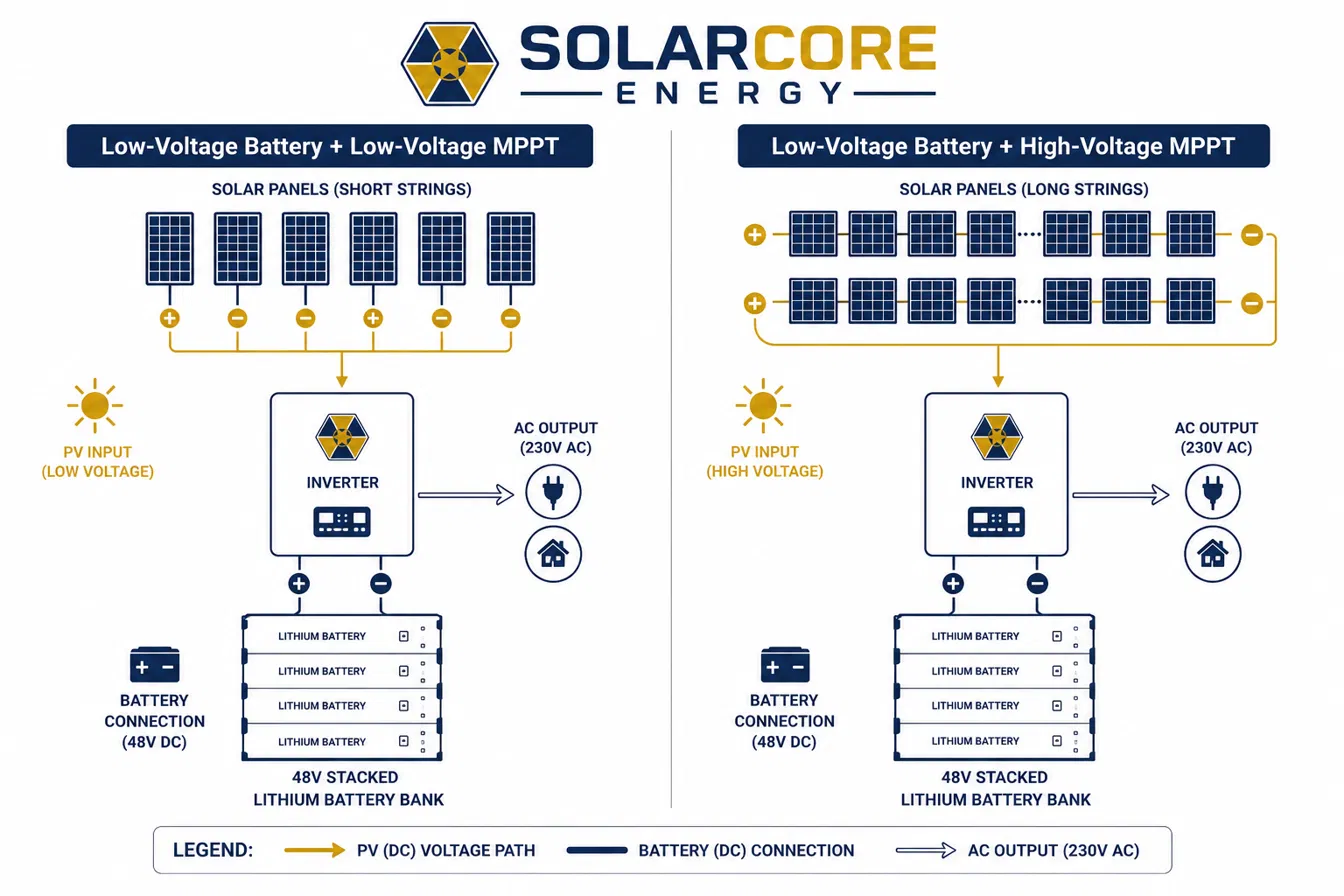
MPPT input voltage refers to the voltage range that the inverter's Maximum Power Point Tracker can accept from the solar PV array. This is entirely separate from the battery nominal voltage. An inverter can have a 48V (low-voltage) battery connection and simultaneously accept solar input up to 500V (high-voltage MPPT range). The two voltage parameters operate on completely different parts of the system.
Battery Voltage: Three Types of LFP Systems
The explosion of lithium iron phosphate battery technology has produced three distinct battery configuration types, each with different design implications:
- Type 1 — Low-Voltage Parallel-Only Batteries. These operate at a fixed nominal voltage (commonly 48V) and can only be expanded in capacity by adding units in parallel. The total bank voltage stays at 48V regardless of how many batteries you connect. These are the most common LFP batteries in the Nigerian residential market. Brands like Pylon Tech, Felicity Solar, and many others fall in this category.
- Type 2 — High-Voltage Series-Stackable Batteries. These are designed to be connected in series, building up to a defined maximum voltage — often 100V to 500V depending on the brand. Each additional battery increases total bank voltage. These systems require inverters specifically designed for high-voltage DC inputs on the battery port.
- Type 3 — Switchable Voltage Batteries. A newer category, pioneered by brands like UHome, allows the same battery hardware to be configured for either low-voltage or high-voltage operation depending on how units are arranged and the system they are connected to. This flexibility reduces inventory complexity for installers.
Understanding which type of battery you are working with is not optional — it determines which inverters can be connected to it, how the system must be wired, and what protection devices are required.
The Part Most Designers Get Wrong: Two Voltage Parameters in Every Inverter
Every hybrid inverter has two separate voltage specifications that govern different parts of the system. Conflating them is the most common design error we encounter in the Nigerian solar market.
Parameter 1: Battery Nominal Voltage (DC Bus Voltage)
This is the voltage at which the inverter charges and discharges the battery bank. For most residential hybrid inverters sold in Nigeria — Deye 5kW, SRNE, Voltronic, Easun — this is 48V. Some commercial-grade inverters support higher battery voltages (96V, 192V, or up to 500V depending on the model).
Parameter 2: MPPT Input Voltage Range
This is the voltage range the inverter's built-in MPPT charge controller can accept from the solar array. This is entirely independent of the battery voltage. The Deye SUN-5K-SG03LP1-EU, one of the most widely sold residential inverters in Nigeria, is a perfect example: it has a 48V battery bus, but its MPPT input accepts solar array voltage up to 500V. This means solar panels can be strung in series to much higher voltages than the battery bank — improving efficiency in the solar harvest section without requiring a high-voltage battery.
Error Type 1 — Under-Stringing Solar Panels
This occurs when the designer assumes that because the battery is 48V, the solar panels must also be kept near 48V. At 48V panel strings on a 500V-capable MPPT, the designer is using approximately 10% of the available MPPT input capacity. The result is a poorly performing system that the client blames on poor-quality panels, when the real cause is a design decision made in the first week of the project. The energy loss compounds daily across the system's entire operating life.
Error Type 2 — Mismatching High-Voltage Batteries to Low-Voltage Inverters
This occurs when a designer assumes that because a new battery brand supports high-voltage series configuration, it can be used with any inverter in stock. Connecting a 200V series battery bank to a 48V battery inverter is a serious fault condition — the inverter's battery management circuitry is designed for 48V, not 200V. Results range from immediate protection tripping to permanent inverter damage.
What This Means for Panel String Design
The MPPT input voltage range of the inverter determines how solar panels are strung in series. If your inverter's MPPT accepts up to 500V, and you are using 400W panels with a Voc (open-circuit voltage) of approximately 37V, you can string up to 13 panels in series (13 × 37V = 481V, within the 500V limit) per MPPT input. This gives you a high-voltage, high-efficiency string that the MPPT can harvest from optimally.
If someone designs that same system with panels strung to 48V — approximately one to two panels per string — and connects multiple strings in parallel to compensate, they generate more current at lower voltage, which means larger cable cross-sections, more cable heat loss, and a more complex and expensive DC cabling run. The difference in performance between a correctly strung and incorrectly strung solar array, using identical panels and an identical inverter, can be 15 to 25% in annual energy harvest.
The Practical Questions to Ask Before You Buy
Whether you are a property owner evaluating a solar proposal or a technical manager reviewing a contractor's submission, these questions reveal whether the designer genuinely understands their system:
- What is the nominal voltage of the battery bank? Is this battery designed for low-voltage parallel configuration, high-voltage series configuration, or both?
- What is the inverter's battery nominal voltage (DC bus voltage)?
- What is the MPPT input voltage range? Are the battery and MPPT specifications compatible with the proposed configuration?
- What is the Voc and Vmp of each panel? How many panels are strung in series per MPPT input? Does the resulting string Voc stay within the inverter's MPPT maximum input voltage at the lowest ambient temperature expected on site?
- Has the designer documented their panel string voltage calculation? Can you see it before signing?
A solar engineer who cannot answer these questions with confidence is working from intuition, not engineering. That distinction matters when the system they design will be running in your building for the next 25 years.
The rapid evolution of solar hardware since 2020 has created an extraordinary opportunity: systems can now be designed with far greater precision, efficiency, and flexibility than was possible even five years ago. But that same evolution has also widened the gap between engineers who have kept up with the technology and those still applying 2017 design rules to 2026 hardware.
At Solarcore Energy, every system design begins with documented specifications for all three voltage parameters: battery nominal voltage, MPPT input voltage range, and solar string voltage calculation. These are the first engineering checkpoint on every project — before a single component is specified or a price is quoted.
Want to See the Calculations Behind Your System Design?
Use our free solar sizing configurator to generate an indicative system design — or contact us directly. Every Solarcore proposal includes documented panel string voltage calculations. We show our working before you sign anything.
Joseph Olubato
Founder & Principal Solar Engineer, Solarcore Energy Limited. 10+ years engineering energy and telecom infrastructure across Nigeria and West Africa.